


In production engineering, some of the most important decisions are made with incomplete information.
For Jean-Christophe Barbier, one question kept resurfacing throughout his career: how do you make good decisions when you do not know exactly what is happening inside the well?
That question has been the driver behind Wellstarter’s flow allocation technology.
How it started
When a new well is drilled, drilling mud remains in the wellbore long after drilling operations have been completed. Before production can begin, operators must remove this mud and ensure the well is properly cleaned up.
The challenge lies in knowing whether that process has been successful.
“During the clean-up phase, the mud can act like a brake, making the well less productive,” recalls Barbier. “Often, the operator or production engineer is very uncertain whether there is still mud in the well or not.”
Initially, the team explored ways to actively mobilise and remove residual mud from the well. But as development progressed, a more fundamental question emerged.
What began as an effort to understand well clean-up soon evolved into a broader objective: understanding where production was coming from, how it changed over time, and whether a well was performing as expected.
Wellstarter’s solutions emerged not from a research project, but from a need for better information.
Building a picture of the well
For production engineers, uncertainty is often the biggest obstacle to good decision-making.
Field development decisions, intervention planning, reservoir models and future drilling strategies all depend on understanding where production is coming from and how it changes over time.
“Petroleum engineering is largely about understanding how the well behaves,” says Barbier. “The challenge is that there is actually very little information available, especially deep in the well.”
Flow allocation data influences reservoir models and future development decisions, including where the next well should be drilled.
As Barbier puts it:
“At the end of the day, we want to help operators decide on their next target or help planning their next intervention.”
Filling the information gap
The industry already has several proven ways to gather production data.
Production logging tools (PLTs), reservoir models, digital twins and tracer technologies have all played an important role in helping operators understand well performance and flow behaviour.
However, there is still a lot to be improved in this field. These methods can involve high cost, operational risk and can even be technically unfeasibly in many cases. The team saw an opportunity to challenge existing methods, and to bring a new source of quantitative downhole information to the table.
The objective was to provide another layer of insight, helping operators build a more complete picture of flow allocation and well performance.
Seeing the potential in temperature
The breakthrough came from a deceptively simple observation.
When measuring close to the reservoir, engineers have relatively few physical measurements available to them. While pressure has long been central to production analysis, Barbier believed temperature remained an underused source of information.
“If you want to measure close to the reservoir, you don’t have many choices,” he explains. “It’s either pressure or temperature.”
By generating controlled heat pulses downhole and monitoring how those thermal signals travel through the well, the team realised they could identify production from specific zones.
The concept sounded simple. The execution was not.
The system needed to generate reliable heat pulses in a hostile downhole environment and produce signals strong enough to be detected and interpreted accurately. At the same time, sophisticated physical and thermal models were required to translate those signals into meaningful production data.
Wellstarter worked alongside leading multiphase flow modelling experts, including SINTEF in Trondheim, to build and validate that interpretation layer.
The moment everything changed
Years of modelling, simulation and engineering development eventually led to the first field trials.
The initial tests took place in a controlled water environment in Ålgård, Norway.
“When we first activated it and saw the signal, we knew it was extremely good,” recalls Barbier.
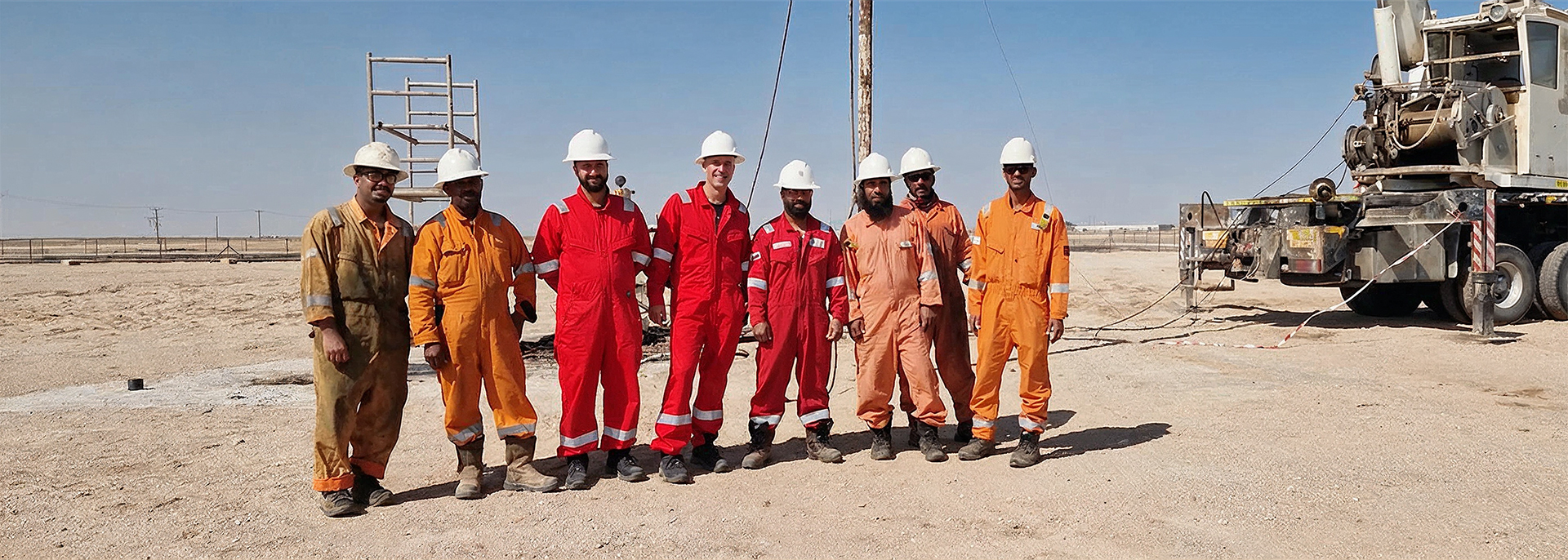
The next step was a deployment in a producing well in Oman.
“When we saw the results, it was much better than we could have hoped for. That was a crazy feeling.”
It demonstrated that temperature could provide meaningful flow allocation information in a real operating environment.
As Barbier puts it:
“The temperature signal never lies. If you see something, you know it’s there.”
Why interpretation matters as much as measurement
Demonstrating that the signal could be detected was only the first step. Turning that signal into actionable production insight is where the real value lies.
“The operator can do the calculations themselves and come to their own conclusions,” says Barbier. “But we need the model to firm up the response and ensure the interpretation is coherent.”
For Wellstarter, a temperature signal on its own has limited value. Understanding what it means is what matters.
That is why physical modelling, engineering expertise and quantitative interpretation remain central to Wellstarter’s approach.
Building trust in a conservative industry
The oil and gas industry is cautious by design. Operators are understandably careful when introducing new technologies into critical production environments. Any new solution must demonstrate reliability, credibility and operational simplicity.
That reality shaped Wellstarter’s strategy from the beginning. The team deliberately designed the system to minimise operational disruption and avoid introducing additional risk into well operations.
“If you’ve worked in operations offshore, you know there’s always something happening and always a problem to solve,” says Barbier. “If you can provide answers in the background without impacting operations, that’s valuable.”
As more deployments have been completed and operators have seen results, and confidence in the technology has continued to grow.
“When production teams can trust the flow data they’re seeing,” Barbier reflects, “it changes how they operate the well and the decisions they make.”
That, in the end, is what Wellstarter was built to provide: not just measurements, but answers that help production teams operate their fields in a more informed way.
Discuss this article
Have questions? Talk to our engineers.
Our production engineers are happy to discuss this project or how it applies to your specific assets on the NCS.